Switching from Mac
In honor of Tim Cook's retirement, I watched the Apple Special Event, October 2008. This was one of Cook's first public appearances with Apple.
My computer history
I've been a Mac user my whole life. Our family computer was a Mac, when I was growing up, and I had the remarkable privilege of living in an area where the local public elementary school had a computer lab furnished with Macs.
I am, for lack of a better term, an "Apple fanboy." I follow Apple news from Apple-specific sources (Jason Snell in particular). I've intentionally never used a Windows computer for more than an hour or so at a time, and only rarely.
I recently purchased my first non-Mac personal computer, a Framework 12. (Well, pre-ordered, scheduled to ship in October.)
Tim Cook's 6 points
In Cook's presentation in 2008, he talks about 6 things that have allowed the Mac to grow at 2-3x the rate of the PC market as a whole: Better computers, better software, compatibility, Vista, marketing, retail stores.
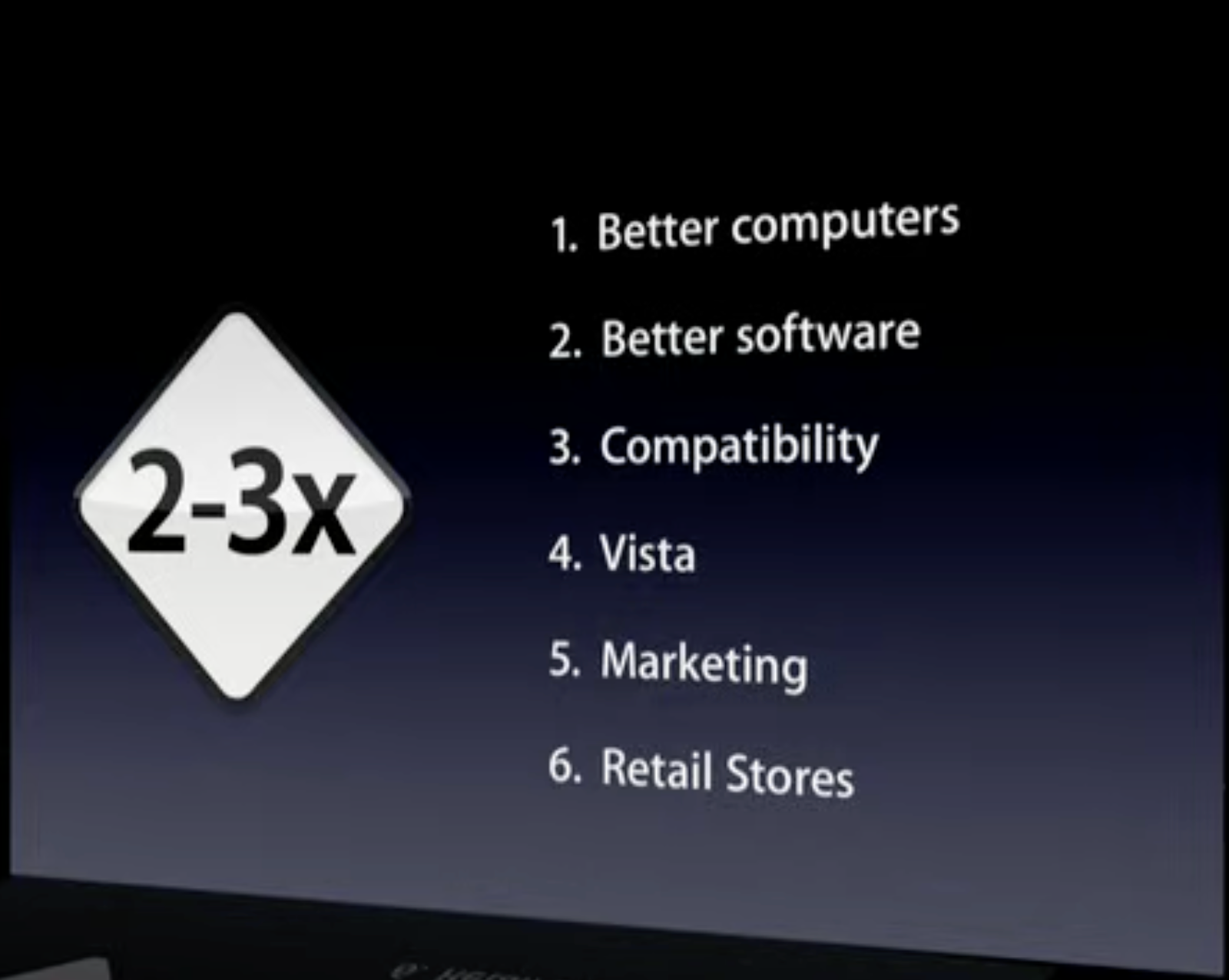
You can watch the talk to hear how Cook applies these 6 points to the Mac in 2008.
What struck me was that Framework is beating Apple in the same ways Apple beat Windows in 2008. Let's look at how they apply to Framework or Linux in 2026.
Better Computers
When you compare a Framework to a MacBook according to the MacBook's strengths, the Framework looks weak. Macs have better screens, better manufacturing quality, and better chips.
But there are a couple places where the Framework 12 that I preordered is better than the Mac. It's a 2-in-1, featuring a 180º hinge and a touch screen. (One of the main things I do on my personal computer is watch YouTube.) The Framework has a USB-A port (and I have a USB-A mouse). The framework is smaller than the smallest MacBook Air (and like small computers).
When I get the Framework, I'll see how much the plastic body or the screen's poor colors bother me. The Framework isn't conclusively better, but I ordered it because I think that subjectively it could be.
Better Software
I like Linux. (You didn't think I was going to run Windows, did you?)
I've used Linux before on secondary computers, I've duel booted, and of course I've used it in Docker and on servers. I appreciate that Linux is fast, stable, and free from bloatware or cooperate advertising.
Fedora is my distro of choice right now. I like the 6-month release cycles and the stability afforded by being associated with the "Enterprise" distros.
Framework recently announced that this latest generation of Framework 12 laptops would include an option to ship with Fedora out of the box, so I thought this was a perfect time to get one.
Compatibility
I may be wrong about this, but my impression is that Linux has more software compatibility in 2026 than macOS does.
I'm a developer, and Linux is often the first platform supported by developer tools and compilers. I certainly regularly run software in Docker Desktop (a Linux virtual machine).
Recently, Valve has pushed their gaming hardware products on top of Linux, leading to increased Linux support for games. Watching certain tech YouTubers analyze Linux in 2026 is interesting because many describe the game support as a deal breaker: they have to stay on Windows to run a particular game. But coming from macOS, Linux's game support would be an improvement.
Vista
At this point in the talk Cook talks about how Vista was a misstep by Microsoft. I don't think Apple has made a similar major misstep (Liquid Glass?) but there are a number of complaints I've had with their software recently. I don't think iterating them is helpful since most are very specific (e.g. let browsers compiled by individuals access the com.apple.developer.web-browser.public-key-credential entitlement).
However one major issue I take with Apple's direction recently is adding subscription-based features to Pages and the iWork apps.
Jason Snell on how Apple is devaluing their brand
I used Pages for writing papers through high school and college, I like the app. And obviously I don't need the subscription features in question. But Apple updating these apps to add an upsell for an expensive subscription that I don't need is a harsh reminder that these apps are controlled by Apple. .pages is a proprietary Apple file format. I can't remove the upsell banner, I can't downgrade Pages, I can't open these files in another app (without first exporting them). Are these practical concerns today, maybe not. But it means that I'm not going to write new documents in Pages in the future.
Most of my issues with macOS are small things. And I'm sure I'll have lots of small issues with Linux too. The difference is Linux gives you the right to modify the operating system (something that Apple explicitly asks you to give up when you agree to their license agreement). This difference will matter when there are big issues.
Marketing
Framework's marketing is really good. Their website is clean, (if not as beautiful as Apple's). The videos on their YouTube channel get hundreds of thousands or millions of views.
And their slogans are chilling. The Framework 13 Pro launch video includes the phrase "This is your laptop. Not ours." Their splash page for the product calls it "The Ultimate Developer Machine." The reason those slogans are effective is because I haven't heard them before. (Apple's marketing looks as great as it always has, but the message is stale. I know Apple laptops are thin and fast and have long battery life.)
Tech, as an industry, is bigger than ever. And it's having more effect on people's lives than ever. But this makes it harder for the big companies making billions of units to capture the magic of creating something new and niche. I've been encouraged by companies like Framework (or for another example, Nothing) because they can capture some of that magic by doing things actually differently.
Retail Stores
Apple still has Framework beat here. Maybe in the future.